Showing posts with label Health. Show all posts

Monday, March 16, 2015

Finding a quiet moment:


 http://antalvali.com/files/images/ongyogyitas_0.jpg


In our lives, no matter our age, there comes a time when it just seems like there are too many things going on. Crunch time on upcoming exams, appointments and chores, and bills to pay, and it goes on and on. It seems like lately, we can never get even one moment to rest and breathe. This can lead to increased stress levels, a decrease of rest and the ability to heal, and it can even lead to more mental and emotional rooted traumas down the line.

This leads us to question...Have we taken the time today to slow down? To appreciate the small things in life that might pass us by when we are stressing about the daily task? When is enough truly enough? When and where do we draw the line and take the time to nurture ourselves? Do all of those tasks need to be done right away, and are they worth the accumulated stress?

These are all questions that are individual and that we ourselves have to ask and to answer. Where is the line between life’s tasks and actually living in the moment? Tomorrow never comes, they say, but it seems no matter how often we are reminded of that fact, we find ourselves consumed by the very routines that are in place to center our lives.

The first step of changing any routine or choice is by changing our perspective on it. When we can look at something from another point of view or in a different light,  sometimes it can make all the difference on how we choose to approach it and take on the task of changing it.

 http://artreachchicago.org/wp-content/uploads/2014/10/self-care-brainstorm4.jpg


One can look at taking time for self care as a way of loving and being kind to oneself. In other words, it’s one thing to say I love myself, it’s another thing entirely to say I deserve time to nurture and rest myself because I love myself. One way of accomplishing this could be setting time to spend with a loved one. It can be as easy as going for a walk with them, or planning time to get your garden ready for the spring. Time in today’s nonstop world is more important than ever before.

So if you’re struggling with something, if you’re feeling worn down, if you notice your ability to cope with the usual task seems harder than usual.... you’re not alone.  Take some time to break free of what has been causing or contributing to your distress and take some nurturing time for you. There is only one you, and you are worth the time.

By Ashley Rocheleau(RMT)

Monday, July 14, 2014

Environmental Toxins

www.yourhealthandmine.net

Even if you carefully monitor what you eat, and pay close attention to the household products and items you purchase, your chance of being exposed to hazardous toxins is still quite high. Lead, arsenic, mercury, PCBs, flame retardants, and an array of other chemicals linked to cancer, birth defects and neurological diseases are well represented in most people’s bloodstream.

These dangerous chemicals and toxins are in the air you breathe, the water you drink, the food you eat, your home and workplace, and the products you use. Over the last 50 years, from 70,000 to 100,000 different chemicals have been introduced into the world‘s markets with about 1,500 new ones added each year.


Numerous clinical studies reveal that common and dangerous toxins are stored in the bodies of a large percentage of the population –- within organs, fluids, tissues, and circulation. In many of the cases studied, toxic body burden exceeded safe exposure limits as set by the Environmental Protection Agency, as these toxins are closely linked to a number of chronic illnesses, developmental conditions, and behavioral problems. Toxins wreak havoc by causing chronic inflammation, DNA mutations, oxidative stress, the disruption of cell signaling, and other critical damage.

You can take action to prevent and reduce your exposure to these harmful toxins right now! That would include switching to non-toxic and natural alternatives for items that you use on your body, in your home and around your yard, to start.
Estimates show most Canadians have somewhere between 400 and 800 chemicals stored in their bodies, typically in fat cells. Because effects from exposure to toxins are difficult to identify, it can be years before problems from exposure manifest themselves as a disease or chronic ailment.

Toxins in Your Home and Workplace
naturalremediesthatwork.com
Many potential toxins are lurking within your home. Toxins can be found in furnishings, flooring, paint, air fresheners, cleaning products, the water you drink, and the air you breathe. Commercial interests often override health concerns associated with many products, in part because related health problems may take years to develop and be difficult to assign cause.

The workplace can also be a dangerous environment. It is a place in which we can encounter many chemicals and products that are also found in the home, that have the potential to cause human harm. There have been countless articles written on both “Sick Building Syndrome” and “Occupational Asthma.” Under these two modern diagnoses, people have complained of a variety of symptoms including watery eyes, runny nose, headaches, dizziness, nausea and tightening sensation in the chest. The curious thing about most of these symptoms is that they have a distinct pattern of getting worse while in the work environment and significantly better over vacations or weekends.

Indoor air can have higher concentrations of toxins than outdoor air. Ironically, these chemical toxins come from the products we use to make our lives better.


Toxins in Personal Care Products

The skin is your largest organ, what you put on it is absorbed into your bloodstream!

www.drfranklipman.com
The average woman uses over 15 personal care products daily, the average man about 6. Each product containing a dozen or more chemicals! Many of these chemicals are carcinogens, neurotoxins and contain reproductive toxins!http://ad.linksynergy.com/fs-bin/show?id=h/on*z09iG0&bids=275461.10000183&type=4&subid=0 See that long list of ingredients on the back of the bottle? Some probably aren't as safe as you'd hope.
The majority of people wash their hair daily with some of these toxic ingredients namely: Sodium lauryl sulfate, Parabens, and propylene glycol.  Sodium Lauryl sulfate is a surfactant (industrial strength), Parabens (preservatives that mimic estrogen, and propylene glycol, moisture retainer (cosmetic form of antifreeze). Why consciously put those in your hair, skin and mouth daily?
Perhaps you’ve reasoned that a little poison is okay and continue using commercialized products. Seeking out responsible skin care products is like making food choices. Just like food, there are alternatives to toxic products. By reading labels, avoiding harmful ingredients this might help you feel a little healthier, contributing to wellness, while reducing unintended consequences of compounded toxins in your body and environment. A win-win!
For more information about toxins in personal care products go to the Environmental Working Group’s Skin Deep Cosmetics Database: www.ewg.org/skindeep.

Environmental Toxins – A Naturopathic Perspective


Toxins commonly come in the form of heavy metals, chemicals and from breakdown products produced by metabolism. The body is constantly working to neutralize and eliminate them.  

A toxic overload happens when the body can’t remove these toxins and they start building up in the cells. Symptoms of toxicity can range from fatigue, muscle aches, joint discomfort and pain, eczema, headaches, or indigestion to more severe diseases including cancer and Parkinson’s Disease. 

From a naturopathic perspective, the main goal is to eliminate exposure to harmful materials while supporting the body to detoxify and eliminate these harmful materials. 

Consuming organic food allows us to avoid many of the pesticides, herbicides, synthetic hormones and antibiotics present in our food system. Switching to safer cleaners and personal care products prevents us from being exposed to chemicals that can contribute to cancer and hormone dysfunction. 

The concepts of “detoxification” and “cleansing” have also been gaining popularity in modern times with the increasing number of toxins surfacing in our environment and a corresponding decrease in health of our population. 

Although we can’t avoid everything, there is much we can do to increase our awareness and support our bodies to eliminate toxins.  Get informed, take action, and if you need extra help your naturopath is here to steer you in the right direction!


Strategies to Eliminate Toxins in Your Home

·  Only use natural cleaning products in your home. You can make your own or purchase from health food stores.
·  Establish a “no shoe” policy in your home. This will reduce toxins and pesticides brought into your home from outside.
·  Avoid using chemical pest control products. Look for safe, non-toxic alternatives.
·  Use toxin reducing house plants. Certain house plants are useful in cleaning the air inside your home.
·  Change or clean your furnace or A/C filters at least every 1-3 months depending on use.
·  Switch over to natural brands of toiletries including toothpaste, antiperspirants and cosmetics.
·  Avoid using artificial air fresheners, dryer sheets and fabric softeners as these will pollute the air in your home.
·  Avoid using lawn care chemicals to prevent residue from being tracked into your home.
·  Have your tap water tested and if contaminates are found, install water filters.
·  Use low-VOC paints, caulks, sealants, finishes and carpeting
·  Ventilate all year round to bring fresh air into your home.

Sunday, July 6, 2014

Is Golf Giving You A Headache?


Golf is a popular sport played by enthusiasts of all ages here in the Ottawa region. Golf has some “usual suspects” when it comes to injury. Low back pain, golfers elbow, and rotator cuff injuries of the shoulder, to name a few. Range of motion of the trunk and upper extremities is the key to a successful golf swing. 

Flexibility exercises not only have the potential to prevent injury, but also to improve golf performance. Unfortunately, as you get older, your flexibility is likely to decrease, predisposing you to injury. Golf is a game of repetitive twisting and rotation of the trunk. Excessive rotation puts a shear stress on the spine, which may increase risk of injury.

Injury prevention for the low back includes proper swing mechanics, such as rotating both the shoulder and hip equally in the backswing, and keeping the spine vertical (no hyperextension) on follow through.

Exercising the muscles of the core, which are the powerhouse and foundation of the golf swing, will assist in the long shots and increase crispness and control in the short game. So what’s all this about headaches? Was that just a catchy title? No! Neck pain and cervicogenic headaches can be chronic and common in some golfers. If doing as you’re told (keeping your head down instead of admiring your Lori Kane shot), you can jam your upper cervical joints and sprain the suboccipital muscles, especially if your follow through is tense. 

So it’s time to add neck stretching to your pre-game routine, and ensure that you have a relaxed follow through on your swing. See your chiropractor if your symptoms persist. So stretch, warm up, relax, and have fun. Bring on lower scores, fewer lost balls and bunkers!

Saturday, July 5, 2014

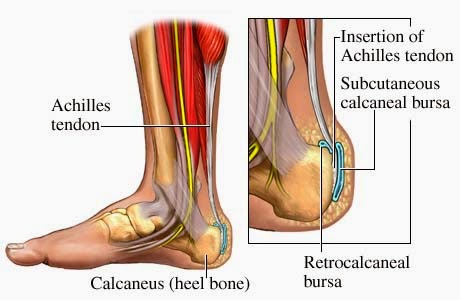
Achilles Tendonitis


Achilles tendonitis is a common injury in the running community. It is an inflammatory ailment that leads to swelling, pain and tissue damage. It results from repetitive strain, which in turn makes it more susceptible to tearing or even rupturing.

The Achilles tendon attaches to the heel of the foot, as do the posterior muscles of the leg, which help to plantar flex the foot (point the toes down). It is responsible for providing the push that drives the foot down and forward when walking, running, and jumping. All in all, it generates a lot of tension and absorbs a lot of force. It‘s involved in most actions of the lower extremity and becomes more susceptible to tendonitis when engaging in sports, where it is under a constant, repetitive load.

A further danger exists for triathletes, when making the transition from swimming to running. The tendon has been in a shortened position during the swim and then has to elongate during the run. Without stretching the tendon beforehand, a strain on the fibers or even a tear can occur because the fibers are “accustomed” to the shortened position.

Prevention plays a major role in dealing with tendonitis. Proper running form, appropriate footwear and a good flexibility program are important areas to start with. Massage, ART, and acupuncture are all treatments that not only help to restore flexibility once tendonitis has developed, but are viable ways to prevent it as well.

Tendonitis rarely goes away on its own. Usually, the longer you have tendonitis the longer you will need treatment before you see improvements. Massage is an excellent way to maintain the integrity of the muscles by increasing circulation (bringing nutrients to the area and flushing out metabolites) and reducing tension on the fibres. ART works quickly to break down adhesions and scar tissue that form with tendonitis, helping to restore full range of motion. Acupuncture is another effective way of reducing inflammation and pain.

Friday, July 4, 2014

Remedial exercise: Helping you heal faster


Remedial exercises are used to improve your body’s health. They are useful for rehabilitation after an injury or simply as part of your overall wellness plan. Your health care provider may ask you to do exercises at home, or they may be used during your treatments. In general, there are four primary types of remedial exercise: range of motion, stretching, strengthening, and cardiovascular. Most conditions will be given a combination of at least stretching and strengthening exercises, although many will be given components of all four.

In order to understand how remedial exercises work, it is important to understand how the body’s musculoskeletal system works. Every joint in the body has multiple muscles working to stabilize and/or move it. While some muscles are working to move your joints, others will work to stabilize them or slow the movements. This ensures that movements are smooth and controlled, and helps prevent injury.

Back Pain


Low back pain affects 85% of the working population, and 80% of Canadians will suffer from low back pain in their lifetimes. In a recent Environics poll, nearly two-thirds of adults in Canada said they experienced moderate to severe back pain in the past year, causing them to lose anywhere from a day to more than a month off work.

Health Canada estimated that musculoskeletal disorders, including back pain, cost society $16.4 billion in combined direct (treatment and rehabilitation) and indirect (lost productivity) costs.


Back pain is a leading cause of prescription (and non prescription) drug use, medical visits, hospitalizations and restricted physical activity. In Ontario alone, back pain accounts for one-third of lost work claims, according to the Institute of Work and Health.


The main causes of back pain are: improper lifting, carrying heavy articles, sports injuries, poor posture, health conditions, and work related injuries.


Many ordinary activities, like working at a computer or driving, can lead to a posture that puts additional pressure on your lower back. By the time you feel pain, the problem has most likely been in the making for some time. In fact, in 1999, Canadians spent $21.5 million on back pain products. Yet while many of these avenues offer relief, they may not get to the root of the problem.


Back pain affects Canadians of all ages, and slightly more women than men. Their effect has the greatest impact on adults under 45, and is only second to arthritis in those 45 to 65 years of age. For them, it’s the number one cause of limited activity, keeping them from work, out of the game, and away from the garden.


The findings also show that almost half the people asked said that coping with back pain made it more difficult to concentrate on everyday tasks – which means not just dealing with the pain, but also having to manage the disruption it causes in their life and the lives of those around them.


Almost nine out of 10 Canadians rated back pain as an important public issue. While some people treat only their pain, others ignore it altogether, dismissing its severity or thinking it will just go away. But because so many people’s everyday activities contribute to the problem, backs are routinely and repeatedly exposed to risks. And the reality is that ignoring the problem doesn’t make it go away. In fact, it can make it worse. For Canadians suffering from back pain, getting back on their feet means taking an active role in treating not just the symptoms, but also the problem. And to help them, chiropractors are able to offer a variety of treatment options.


Common questions about low back pain:


How do you get back pain? One of the most common causes of low back pain (LBP) is an overuse syndrome that creates muscular pain. However, other significant causes of low back pain include direct trauma, lifting and twisting, age-related changes creating degeneration, and postural stresses.


How is it treated? Chiropractors are practitioners of choice when it comes to back pain, and have a high rate of patient satisfaction. About four million Canadians consult a chiropractor each year. Joint manipulation and home-based exercises are the best first line treatment options for most causes of LBP; a supervised chiropractic program is beneficial.

Three recent reports have concluded that increased utilization of chiropractic care can contribute to improved productivity and reduce benefit costs.
As well, patients treated by a chiropractor for back pain returned to work sooner and had reduced rates of chronic problems and hospitalization.
Reports demonstrate that chiropractic is a more effective – and more cost-effective – care for occupational and non-occupational back injuries and related conditions than other common forms of treatment. And chiropractic can play an even greater role in improving organizational health and productivity, and reducing absenteeism and disability.

Is lower back pain really a serious problem? First of all, if it makes life more difficult for you, that’s serious in itself. Even if it goes away in a few days, you haven’t really gotten rid of the problem. It will most likely return and if left untreated, could be more debilitating the next time, which is why we recommend seeing a chiropractor at the first sign of back pain.

Lower back pain can also be accompanied by a variety of symptoms, some of which indicate very serious problems. Do you currently have, or have you ever had:
• Leg pain with numbness, tingling and/or weakness?
• Back of leg pain with coughing or sneezing?
• Difficulty standing up after sitting for any period of time?
• Morning stiffness?
• Pain after extended walking?
• Pain in your hip, buttock, thigh, knee or foot?

If you’ve answered “yes” to any of these symptoms, it’s time you got help from a doctor of chiropractic. What will a chiropractor do?

Chiropractors use highly specialized, hands-on healing techniques (called adjustments) to correct spinal problems and offer long-term relief.
Your first visit will include neurological, orthopedic and chiropractic examinations, and if necessary, an x-ray may be recommended to assist in diagnosing your problem.
Once your chiropractor fully understands your condition he’ll give you a complete explanation of your test and x-ray results, along with an effective plan of treatment. Next step? Relief!

How does it work? Through chiropractic adjustments, your body is given the opportunity to heal itself. That’s because once the spine is properly aligned, your entire nervous system can work the way it was intended. Health is restored naturally to your lower back and your whole body.


But long-term relief from back pain is a team effort. There’s plenty you can do as well. Consider a healthier lifestyle, moderate exercise, a well-balanced diet, and improving your posture. Your chiropractor will do the rest by providing your body with the necessary adjustments to help your spine be healthier and stay healthier so you can get back on track.

Chiropractic Care and Children


Children benefit from chiropractic care for the same problems for which adults are treated, which are predominantly musculo-skeletal disorders. For example, children have a fairly high incidence of back pain and other musculo-skeletal problems caused by participation in sports, sitting in desks at school, computer activities, and the frequent tumbles and falls active children experience.

Chiropractic care is widely recognized as one of the safest, drug-free, surgery-free therapies available for the treatment of spinal pain syndromes. Few other therapies can demonstrate a better safety record. Provincial governments across Canada recognize that the chiropractic profession’s scope of practice includes treating patients of all ages.

Are chiropractors trained to treat children? 
ecoactionteams.ca
Yes. Chiropractors have seven years of university level education and training including 756 hours of training exclusively in adjustment techniques. Treatment for children is adapted to the age and smaller frame of the child and is delivered in a gentle manner to which children respond well.

What childhood conditions can chiropractors treat? 
More than 44 studies have been conducted into the effectiveness of chiropractic treatment for neck and back pain alone and there is well-documented evidence of the prevalence of back pain in children. Young children can also benefit from a spinal check-up at key stages in the same way that they benefit from eye examinations and dental check-ups. For example, starting to sit, crawl and walk are developmental points when a check-up will confirm that the spine is functioning properly or provide an early warning of any potential problems.

Chiropractors also consistently see evidence that spinal adjustment of infants and children has many positive effects for a variety of conditions, however; well-controlled research studies are required to better understand some of the benefits that are commonly seen in practice. As research unfolds, studies are confirming these benefits. For example, in recent years there have been two important studies investigating the effectiveness of
chiropractic care for treating childhood colic and asthma.

A research report published in the Journal of Manipulative and Physiological Therapeutics concluded that “spinal manipulation is effective in relieving infantile colic.” The study compared the effect of chiropractic treatment with a commonly prescribed medication used to relieve infantile colic. The results of this study are so compelling that the Danish Public Health Authority has given its public health nurses approval to refer
infants with colic to chiropractors.

Another study published in the New England Journal of Medicine, looked at chiropractic care as complementary therapy for children with medically-managed asthma. The study concluded that while chiropractic treatment did not affect lung function as measured by spirometry, there was a tread toward improvement in the patients’ quality of life based on reduction in the amount of medication taken, as well as diminished severity of asthma attacks.

Can chiropractic treatment replace medical care? 
No. Depending on the patient’s condition, chiropractic care may be the primary treatment for the symptoms. In other situations, chiropractic care may be one aspect of treatment. Chiropractors frequently work in partnership with other health professionals where the skills of both apply to enhancing a patient’s well-being.
As well, chiropractors will refer patients to other health professionals when appropriate. The profession has a very cooperative relationship with family physicians who are a major source of referral to chiropractors.

Do Canadian pediatricians support chiropractic care for children? 
The chiropractic profession supports an integrative and collaborative approach to children’s health care and welcomes both jointly managed patient care and cooperative research into children’s health with the paediatric profession. The Canadian Paediatric Society’s position statement on chiropractic care encourages physicians to co-manage care when patients are also receiving treatment from a chiropractor.
For more information on the chiropractic profession and chiropractic care visit the Canadian Chiropractic Association website at www.ccachiro.org or the Back Pain Channel at www.medbroadcast.com.

This document was written and distributed by the Chiropractic Communications Working Group (CCWG). The CCWG is comprised of representatives of the Canadian Chiropractic Association, Ontario Chiropractic Association, Canadian Memorial Chiropractic College, and Canadian Chiropractic Protective Association.

Thursday, July 3, 2014

Common Injuries Caused by Running

alexloves.com


Plantar Fasciitis  
laserstim.net
The plantar fascia (fash-ah) is a thick band of tissue that connects your heel to the base of your toes. When it is torn, inflamed or over-stretched, this is called plantar fasciitis (fash-e-it-is). This condition can be a result of:
• An acute injury (strain) that places an excessive load on the foot
• Prolonged or excessive pronation (flat foot) of the foot
• A high arch
• A change in footwear
You will often feel the pain at the base of your heel when you step out of bed in the morning. This injury can be very pesky; it can prevent you from running for weeks, sometimes months.

Achilles tendonitis
footdoc.org
The Achilles tendon stems from the muscles in your calf and attaches to your calcaneus bone, or the heel of your foot. Achilles tendonitis is characterized by pain when the foot is plantar flexed, such as when you’re walking on your toes, and is a condition that develops as a result of repeated microtrauma. scarring, or the presence of adhesions in the tendon. It contributes to discomfort while running or playing other sports. Rest and ice are important in healing this injury, as well as professional assessment and treatment.

Self-management techniques:
• Buy quarter-inch heel lifts or Dr. Scholl’s gel heel cushions for your shoes. They are available at our clinic.
• Wear a heated ankle wrap throughout the day to improve circulation.
• Massage your Achilles tendon with ice to prevent poor-quality blood vessels from forming.
• Do the push-against-the-wall stretch regularly, with your rear knee straight, then slightly bent.

Shin splints
richwoodstrack.com
More of a catch-all term than an actual medical condition, “shin splints” refer to any tightening of the muscles, tendons, and even the covering of the bones in your shins. They are especially common among beginning runners, those using old running shoes, those with a rigid or high-arched foot, those who land on the foot incorrectly, and those who dramatically increase their mileage. Please have them checked as they can lead to stress fractures. Do not run if you have shin pain!

Some self-massage tips: Sit in a chair. Place one thumb in the groove between your shin bone and shin muscle (the one on the outside) of the leg that hurts. Place your other thumb on top for support. Rub down the leg. Then move your thumb about an inch to the outside and rub down your leg again. Move an inch to the outside again, and so on. Do this as often as possible, lightly at first and more deeply as the injury begins to heal.

Runner’s knee
prolotherapy.org
You know you have runner’s knee (also called Patello-femoral or chondromalacia patellae) when you feel pain beneath your kneecap while running. It is caused by the kneecap not tracking properly and rubbing against the femur (thigh bone), and can be aggravated by walking down stairs or sitting with the knee bent for a long period of time. One reason for this misalignment is poor biomechanics of the foot, ankle, hip, and knee that leads to excessive wear and tear on the patella. A compression injury may also lead to pain and discomfort in this area.

Iliotibial Band Syndrome
Iliotibial Band Syndrome (IBS) is one of the leading causes of lateral (outside) knee pain in runners. The iliotibial band is a superficial thickening of tissue on the outside of the thigh, extending from the outside of the pelvis, over the hip and knee, and inserting just below the knee. The band is crucial to stabilizing the knee during running, moving from behind the femur (the thigh) to the front of it during the gait cycle. The continual rubbing of the band over the bone, combined with the repeated flexion and extension of the knee during running, may cause the area to become inflamed or the band itself may become irritated.

Symptoms - The symptoms range from a stinging sensation just above the knee joint on the outside of the knee, hip, or along the entire length of the iliotibial band, to swelling of the tissue at the point where the band moves over the femur. The pain may not occur immediately, but will worsen during activity when the foot strikes the ground if you over-stride or run downhill, and may persist afterward.

Causes of Injury – Iliotibial Band Syndrome is the result of both poor training habits, rotation of the hips and anatomical abnormalities:
1. Running on a banked surface, such as the shoulder of a road or an indoor track.
2. Inadequate warm up or cool down.
3. Running excessive distances or increasing mileage too quickly.
4. Anatomical abnormalities, such as genu varum (bow legs), leg length discrepancy, or postural imbalances.


Hamstring pain
Your hamstring muscles are actually a combination of three separate muscles located on the back of your leg, running from your lower pelvis to your knee. They help mainly to flex the knee and extend the hip. If you suffer from hamstring pain, you may have a degenerative disc disease or an abnormal pelvic tilt, problems stemming from your back.

Hip, neck and back pain
Running produces an added amount of pressure to the spine and the intervertebral discs that supply cushioning and lubrication to these joints. If your spine is in any amount of misalignment, certain risks apply not only to the spine itself, but also to the surrounding muscles and tissues.
As you run, you could be providing the motion that initiates or further aggravates your discomfort. Proper running posture is key in reducing these factors and allowing your body to work most efficiently, and at its optimal performance. If any one of these areas becomes misaligned, chances are that if left unchecked, it could precipitate problems in other areas.