Good Posture...just how important is it?
Posture ranks right up at the top of the list when you are talking about good health. It is as important as eating right, exercising, getting a good night's sleep and avoiding potentially harmful substances like alcohol, drugs and tobacco. Good posture is a way of doing things with more energy, less stress and fatigue. Without good posture, you can't really be physically fit.
Surprised? Well, you're not alone. The importance of good posture in an overall fitness program is often overlooked by fitness advisers and fitness seekers alike. In fact, the benefits of good posture may be among the best kept secrets of the current fitness movement. The good news is that most everyone can avoid the problems caused by bad posture...and you can make improvements at any age.
Good Posture is Good Health
We're a health conscious society today and good posture is a part of it. Because good posture means your bones are properly aligned and your muscles, joints and ligaments can work as nature intended. It means your vital organs are in the right position and can function at peak efficiency. Good posture helps contribute to the normal functioning of the nervous system.
Without good posture, your overall health and total efficiency may be compromised. Because the long-term effects of poor posture can affect bodily systems (such as digestion, elimination, breathing, muscles, joints and ligaments), a person who has poor posture may often be tired or unable to work efficiently or move properly.
Even for younger people, how you carry yourself when working, relaxing or playing can have big effects. Did you know that just fifteen minutes reading or typing when using the wrong positions exhausts the muscles of your neck, shoulders and upper back?
 |
| achesawaytoronto.ca |
Poor Posture? How does it happen?
 |
| achesawaytoronto.ca |
Often, poor posture develops because of accidents or falls. But bad posture can also develop from environmental factors or bad habits. This means that you have control.
Today, posture-related problems are increasing:
• As we become a society that watches more television than any previous generation;
• As we become a more electronic society, with more and more people working at sedentary desk jobs or sitting in front of computer terminals;
• As more and more cars are crowding our roads, resulting in accidents and injuries; And as we drive in cars with poorly designed seats.
In most cases, poor posture results from a combination of several factors, which can include:
• Accidents, injuries and falls
• Poor sleep support (mattress)
• Excessive weight
• Visual or emotional difficulties
• Foot problems or improper shoes
• Weak muscles, muscle imbalance
• Careless sitting, standing, sleeping habits
• Negative self-image
• Occupational stress
• Poorly designed work space
Poor Posture and pain
A lifetime of poor posture can start a progression of symptoms in the average adult. It can start with...
Fatigue - your muscles have to work hard just to hold you up if you have poor posture. You waste energy just moving, leaving you without the extra energy you need to feel good.
Tight, achy muscles in the neck, back, arms and legs - by this stage, there may be a change in your muscles and ligaments and you may have a stiff, tight painful feeling. More than 80% of the neck and back problems are the result of tight, achy muscles brought on by years of bad posture.
Posture is important to aid in decreasing force on all tendons, muscles, ligaments and joints of the body!
Joint stiffness and pain - at risk for "wear and tear" arthritis, or what is termed degenerative osteoarthritis. Poor posture and limited mobility increase the likelihood of this condition in later years.
Self-Test for Posture problems
The Wall Test
1. Stand with the back of your head touching the wall and your heels six inches from the baseboard.
2. With your buttocks touching the wall, check the distance with your hand between your lower back and the wall, and your neck and the wall. If you can get within an inch or two at the low back and two inches at the neck, you are close to having excellent posture. If not, your posture may need professional attention to restore the normal curves of your spine.
The Mirror Test
(Front view) Stand facing a full length mirror and check to see if:
1. Your shoulders are level
2. Your head is straight
3. The spaces between your arms and sides seem equal
4. Your hips are level, your knee-caps face straight ahead
5. Your ankles are straight
(Side View) This is much easier to do with the help of another, or by taking a photo.
Check for the following:
1. Head is erect, not slumping forward or backwards
2. Chin is parallel to the floor, not tilting up or down
3. Shoulders are in line with ears, not drooping forward or pulled back
4. Stomach is flat
5. Knees are straight
6. Lower back has a slightly for-ward curve (not too flat or not curved too much forward, creating a hollow back).
The 'Jump' Test
Feel the muscles of your neck and shoulders. Do you find areas that are tender and sensitive? Are the buttock muscles sore when you apply pressure? What about the chest muscles?
Your posture is important when you do everything in daily life.
It can be worked on via specific stretches for your imbalances, strengthening for the specific areas, treatments can help you work towards proper alignment of your body.
We can help!
Treatments such as: orthotic therapy, chiropractic adjustments for the different joints of the body that are affected—from the jaw, neck, mid back, lower back, shoulders, elbows, wrists, hips, knees, and feet. As well the Active Release technique is very effective in decreasing adhesions due to imbalances and so is massage therapy.
Anatomy of the Ribs and Spine
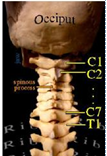
The neck ends at C7 and then the thoracic spine transitions into the chest area or thorax cavity. The thoracic vertebrae are numbered T1-T12—each with a pair of ribs. With ribs comes more prominent Transverse processes (the picture shows them coming off the side of T1). These transverse processes have the ribs at the end of them. The rib tip sits on the vertebral body and rests against the front tip of the transverse process.
One pair (left and right) of ribs per thoracic level make 24 ribs or 12 pairs.
The ribs from T1-T10 make it around to the front and touch the breast bone (sternum). The Rectus Abdominus muscle (six pack muscle in the front) is where the 9-10 rib boundary is. Ribs 11 and 12 are short and are called floating ribs.
The picture shows a rib from the top. The bump sticking out is where the vertebrae joins with the rib.
At each level, the rib shape is contoured differently to define the shape of the chest.
Ribs are not horizontal, they slant downward as you trace them forward. Bands of muscles attach ribs to one another.
These muscles raise and lower the ribs like the handle of a bucket. This is the bellows with which we breathe. A sheet of muscle which seals off the bottom of the chest cavity—the diaphragm— moves upward and downward to also expand the space in the chest cavity. This is a second breathing mechanism.
Sometimes side bending spinal deviations occur which are called Scoliosis, see further.
Rib Dysfunction Syndrome
Rib dysfunction syndrome is often an overlooked condition that has identifiable signs and symptoms and responds to chiropractic adjustments. The vertebrae and the ribs of the thoracic spine make this area fairly rigid. The ribs have several distinct joints: joining them to the back area are the Costo– transverse (between rib and transverse process of vertebrae) and Costo-vertebral (between rib head and vertebral body) joints. Joining them to the front area are the Costo-sternal (between rib and sternum (for ribs 1-5) and Costo-chondral (between rib and sternum for ribs 6-10) joints.
Any of these joint areas can become misaligned due to sitting incorrectly, sleeping in an awkward position, coughing, sneezing, due to spinal curves, scoliosis, asthma, allergies and other conditions such as Scheuermann’s disease, arthritis.
You can feel tension in the upper back, shoulders, and it can lead to pain.
Scoliosis
A normal back when seen from the side is normally curved and when seen from behind is normally straight.
Some people have abnormal curves in the back and they do not have scoliosis. There is however with the abnormal curve loss of vertebral joint motion, muscle imbalances and rib restrictions.
There are different types of scoliosis. Scoliosis is not just any curvature of the spine. Only when the spinal curvature becomes a PROCESS, when the spinal curvature becomes exaggerated progressively over time do we apply the term “Scoliosis”.
The “curve” of scoliosis can be measured in several ways. The most common way is to measure in the number of “degrees”. Normally, the vertebrae are stacked as blocks that are stacked parallel to each other. If the stack bends, then the surface of one block will project an angle to the other ones. This is the angle which is measured.
Scoliosis causes the ribs to rotate, muscles to be short on one side, long on the other and vertebrae to become wedged and lose motion. This can be treated at any age and correction can occur.
Chiropractic adjustments for rib problems
When a rib loses motion or becomes restricted a person can experience a spectrum of symptoms. Sometimes it is described as a “spot in the upper back”—often it is thought it is muscular, tension in the top of the shoulder, discomfort in the chest/back, pain in the back/chest/arm, a sharp knife-like pain, sometimes there is difficulty breathing in or out deeply (dependant on which rib is restricted). Some people have a variety of tests for their heart before figuring out it is a rib problem.
The chiropractic treatment is first aimed at ruling out serious medical problems. It is then followed by a detailed examination of the joint, muscles, ligaments and tendons.
Dr. Rodwin assesses the movement of each of the individual ribs, the attach-ments to the sternum and vertebrae.
If it is found there is a loss of motion— the aim is to restore the movement, address the muscle adhesions, any postural problems or weakness are identified and a course of action is taken. Exercises are normally given to aid in helping, postural advise, and sleeping habits checked. Some female patients have had breast reductions to help reduce the strain on the muscles, ribs, vertebrae in the mid back.
Chiropractic treatment is always worth considering if you have any upper back, chest, shoulder or arm pain.
Active Release technique for muscles involving the ribs
When there are rib problems there are normally adhesions/scar tissue in the muscles, ligaments, tendons either between the ribs, the chest, in the shoulder blade area, the muscles in the top of the shoulder (secondary problem due to compensation), the shoulder and even the arm. These adhesions/scar tissue binds up and ties down tissues that need to move freely. As scar tissue builds up, muscles become shorter and weaker, tension builds on tendons causing tendonitis and nerves become trapped. This can cause reduced range of motion, loss of strength and pain.
Active release is used to reduce the adhesions/scar tissue, which then al-lows the muscles, tendons, ligaments, and nerves to be restored to their normal resting length and function.
Your feet are the foundation of your body
People sometimes wonder how orthotics can correct knee or hip problems. Have you ever had a blister on the bottom of your foot? If you have, you know that you try to avoid putting pressure on it. You change the angle of your foot when you walk and the next thing you know, your knee or hip hurts because you’re walking differently.
Why do people have problems with their feet? It’s simple. The foot is always in motion and under enormous pressure from the body’s weight. As we walk or run, our entire weight lands on our feet, up to 10,000 times a day.
Or, you may have a sore back or hip, and when you alter the way you walk to compensate, your feet begin to hurt. There are many reasons for the aches in the back, legs, and feet – accidental trauma, poorly fitting shoes, or simply signs of age. That’s why people whose feet or legs are not “biomechanically correct” or in perfect alignment, often experience pain in other parts of the body.
Remember, your feet are your foundation. Footmaxx orthotics correct the movement of the foot, and that relieves the problems in the legs, hips and back.
FOOTMAXX ORTHOTICS
Footmaxx orthotics, which are the custom orthotics we use, fit into your shoes. They are similar to insoles, except that they are custom made just for you. These orthotics will correct and improve the way your feet strike the ground. They help your feet move effectively and enhance your natural movement.
Until a few years ago, many orthotics were bulky and that meant people sometimes had to buy special shoes. Not anymore!!! The new Footmaxx orthotics are very thin and lightweight. They fit easily and discreetly into your existing shoes. You can wear your most stylish form-fitting shoes, and still get the proper support and correction from Footmaxx orthotics. They have even come out with orthotics specific for most sports. They have them for hockey, figure skating, skiing, golfing, basketball, baseball, and numerous other sports. Also they have an arthritic and diabetic line of orthotics.
You can learn more about them at www.Footmaxx.com, email Keri-Lyn@Back2Health4you.com or book an appointment with Keri-Lyn.
Biomechanics - the physics of movement
We live in an environment that forces our bodies to react to gravitational forces. With every step we take, our skeleton's alignment and structure influence the process of absorbing and releasing the energy that motion and gravity create. Our feet are highly adaptable. As they hit the ground and begin to absorb load, the motion they undergo is called pronation.
The flexibility of our joints deter-mines how much energy the lower extremity chain (foot-ankle-knee-hip-pelvis-low back) can absorb. For different reasons, both flat and high-arched feet channel a large amount of energy to skeletal structures high in this chain — especially the knee and the hip—making those structures more susceptible to injury
For example, it is common for the kneecap (patella) to develop pain because a flat foot forces the patello-femoral joint to absorb more energy. Running sports add 'impact loading' to the equation. Running and jumping amplify the effects of failed biomechanics. Sprains and strains are likely to occur when joints are poorly aligned or when they absorb forces that should be directed to another part of the body.
How Our Feet Work
Your foot is made up of 26 bones that function as a mobile adapter, then as a shock absorber for the rest of your body. During the mobile adapter phase of walking or running, the foot is a "loose bag of bones" that can be placed on any surface and still help maintain the equilibrium of your leg and body above. As adaptable as your foot's structure must be, it must also be capable of locking itself into a rigid structure so that it can act as a lever, first to stabilize and lift your body's weight and then to propel it forward.
Why Does The Chiropractor Check Your Feet When Your Back Hurts?
The joints and muscles to the body function most efficiently when they are in physical balance. The body is a biomechanical chain where abnormal movements at one link, or joint, can interfere with proper movements at other joints.
When foot imbalance is present, there is a negative impact on the knees, hips and pelvis, and spine.
Improper balance and function of the feet can lead to a variety of conditions including: excessive rotation of the leg bones stressing the knee and twisting the pelvis and spine.
• Excessive rotation of the leg bones stressing the knee and twisting the pelvis and spine.
• Tilting of the pelvis which places tension on muscles and connective tissue, eventually resulting in chronic back problems.
• High levels of heel-strike shock from breakdown of the body's natural 'shock absorbers.' The shock wave then transmits up the kinetic chain, resulting in painful symptoms up to the head, slowed recovery of leg and spine injuries, and aggravation of other conditions